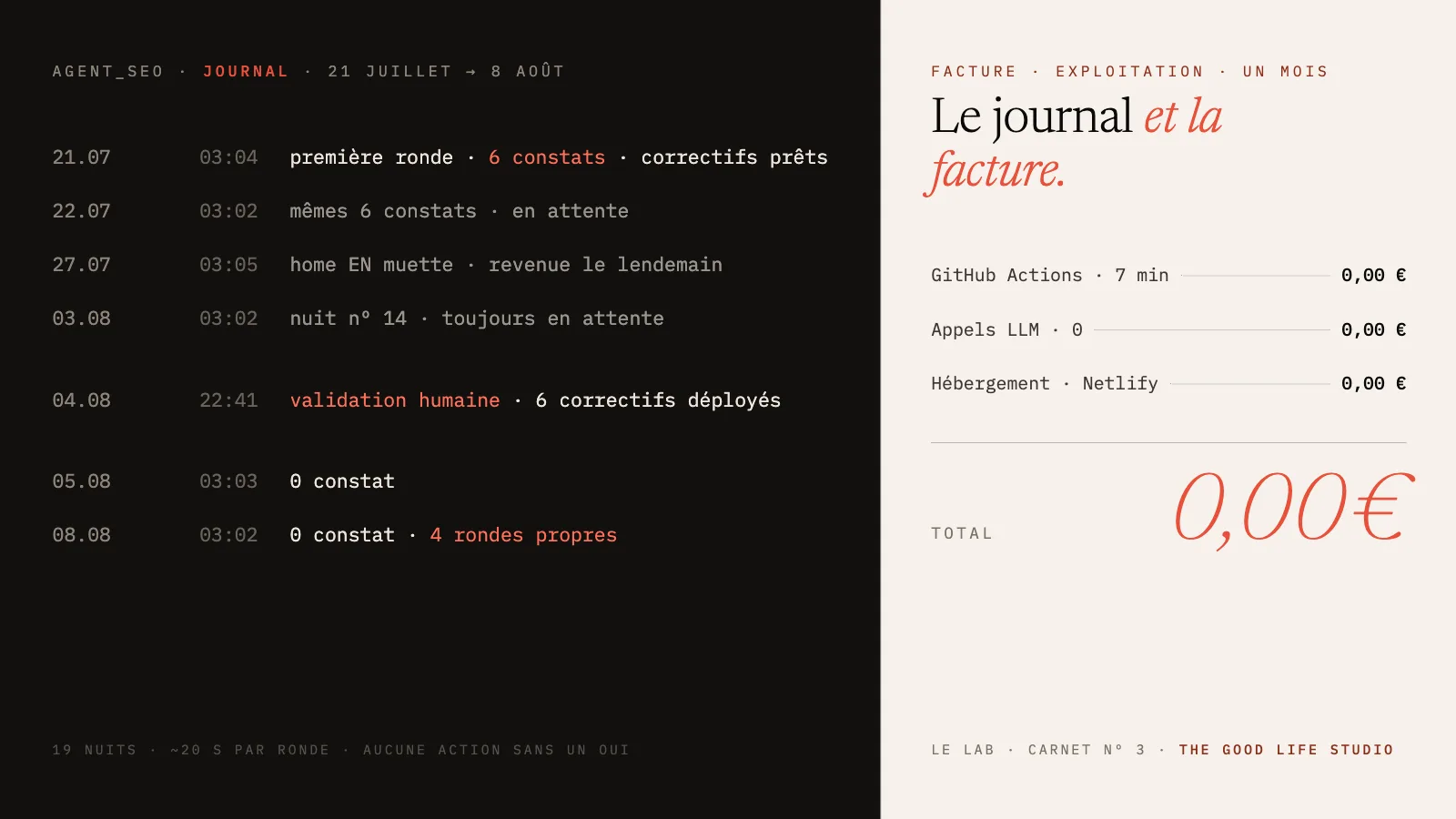
Notebook nº 2 told how this agent works: night rounds, proposals, human approval. This one publishes what nobody ever shows: its full log over one month, and its exact invoice. The numbers come from the Git repository and the execution records; nothing is rounded to look good.
One month, in numbers
- 19 nights of rounds, none missed
- ~20 s for a complete round
- 6 fixes proposed, approved, shipped
- 0.00 € on the infrastructure invoice
The log, uncut
First round on July 21, 3 a.m.: the agent flags 6 problems. Three titles too long (92 to 98 characters, truncated in Google for weeks) and three meta descriptions out of range, across the three language versions of the same article. It prepares the fixes and asks for approval.
Then it waits. Fifteen nights in a row it re-crawls the site, finds the same six problems and asks the same question, without tiring and without acting. Along the way, on July 27, it reported that the English homepage did not answer the crawl; it was back the next day. False positive or micro-incident, the log recorded it.
9 pages crawled. 6 findings: 3 long titles (up to 98 characters), 3 meta descriptions out of range. Fixes ready. Waiting for approval.
12 pages crawled. Same 6 findings as yesterday. Proposal unchanged, still pending. Night nº 14.
12 pages crawled. 0 findings. The 6 fixes are live. Nothing to report.
Approval came on the evening of August 4. Applying the six fixes took five minutes, the quality gate and the deployment chained automatically, and the next round delivered its verdict: zero findings. Four clean rounds since.
The invoice, line by line
- 7 min of CI for the month: 20 runs of about 20 seconds, or 0.3% of the free GitHub Actions tier
- 0 calls to an AI model during the rounds
- 0.00 € of hosting: the site and the reports fit in free tiers
- 0.00 € total operating cost per month
The only line that costs anything: human time. One minute in the morning to read the report (it arrives on its own, as a GitHub issue), one approval decision, and a half-hour session on the evening of August 4 to apply, verify and deploy, driven by a supervised coding agent rather than by hand.
The bottleneck was the human. And that is good news.
Read the log again: fourteen nights separate the first proposal from the approval. The machine cost seven minutes; the decision cost two weeks. The real cost of an agent in production is measured neither in tokens nor in servers: it is measured in minutes of human attention.
And that is good news, because it is exactly the architecture you want: an agent with zero marginal cost, that never forgets, never gets impatient, and leaves the decision to someone who owns the responsibility.
Reference point
The market advertises ranges of 6,000 to 30,000 € for "an AI agent", and monitoring subscriptions at 50 to 100 € per month. This month, our watch cost 0 € to operate and six human decisions. Design is paid once; discipline is free.
Do you need an AI model for this? No. And that is the point.
The night round is a 170-line Python script: HTTP requests, regular expressions, the rules of the trade written down in black and white. No LLM call at 3 a.m. Checking the length of a title does not need intelligence; it needs constancy.
AI works at both ends. At design time: this agent was written, and is maintained, by a supervised coding agent. At execution time: the August 4 fixes were applied by that same agent, visually verified on desktop and mobile before going live. Intelligence at the edges, discipline in the middle: that architecture is what makes the invoice zero.
What the invoice does not show
During those 19 nights, the agent also looked outward: four European AI studios under watch. One of them added eight pages to its sitemap over the period, another three. That signal is worth nothing on the day itself; over a quarter, it maps your competitors' content strategy, for free.
And there is the insurance value. The night a redesign breaks thirty redirects, the round will see it before Google does. That line appears on no invoice, until the day it is worth a lot.
Transposing this to your business
What this month demonstrates: an agent with a clear, bounded scope and human approval costs less to operate than a software subscription. Often: nothing. The real investment is the design, encoding the rules of your trade and plugging the approval loop into the place where your team already lives. That is a project of a few weeks, not a few months. Then it runs.
Incoming quotes, supplier invoices, stock, schedules: every trade has its night rounds waiting for a disciplined agent.