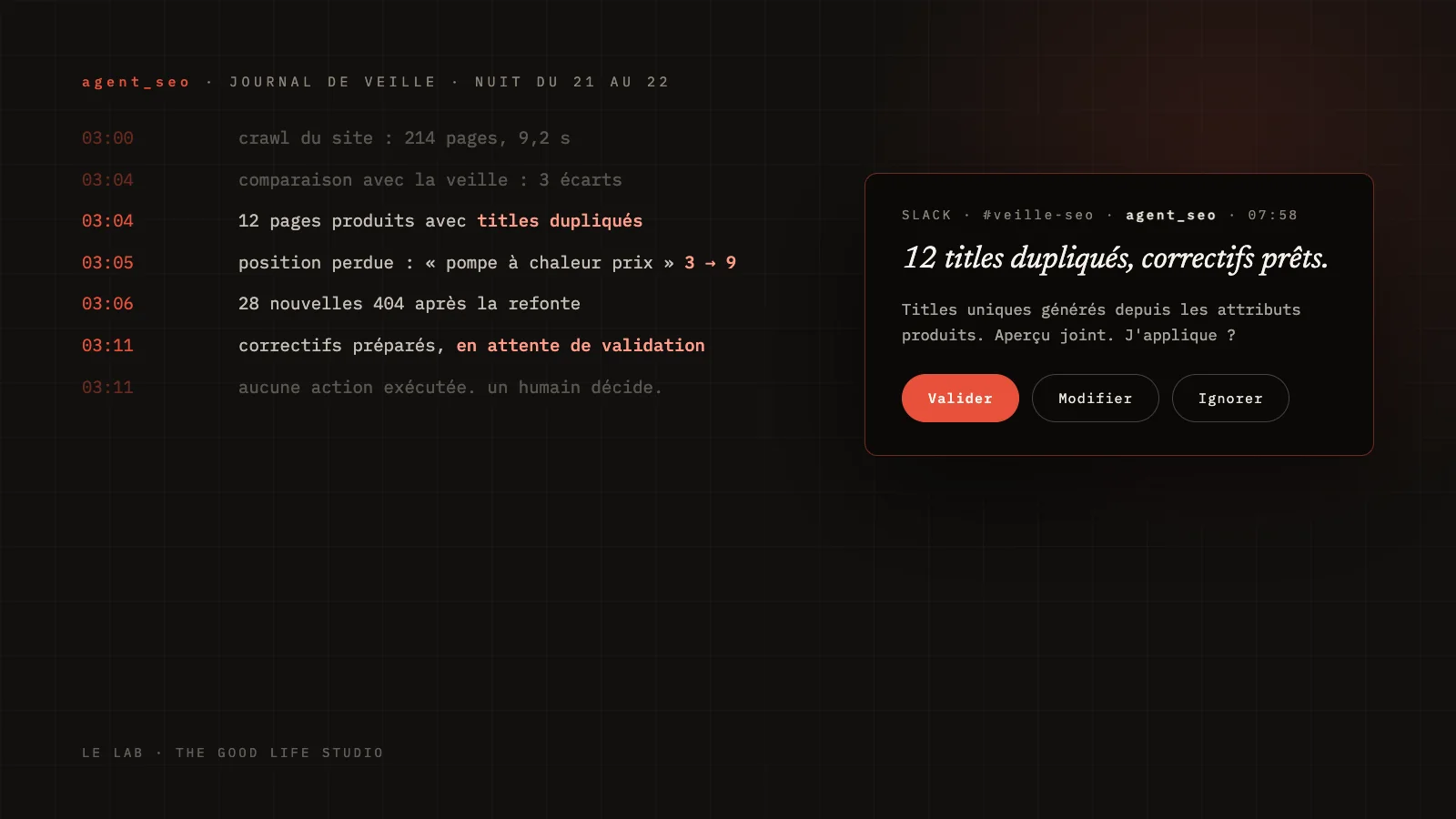
This notebook describes a real deployment of our SEO watch agent, on the site of a Belgian services company. Not another dashboard, not a monthly report: an agent that knows the rules of the craft, watches the site and its competitors every night, prepares the actions, and executes nothing without a human.
The problem
SEO doesn't die in one blow, it dies of small deaths. A duplicate title left behind, a redesign that breaks thirty redirects, a meta description cut mid-sentence in Google, a competitor publishing a guide on your most profitable query. Never anything spectacular. And nobody on the team has time to look every day.
Classic tools alert, a lot. Then someone has to sort the alerts, understand, decide, write the fix, apply it. That link is the one that always breaks.
What the agent knows
The agent carries the rules of search like a companion carries its manual: title and meta lengths, h1 uniqueness, canonical and hreflang consistency, thin pages, content readable without JavaScript, broken internal links, a sitemap that matches reality. Every night, it checks the entire site against that standard.
The difference with an audit: it doesn't hand back a list of problems. It hands back solutions ready to apply. For every finding, the fix comes attached: the new title, the exact redirect, the rewritten meta.
The night watch
An excerpt from a recent patrol, as is: 3 a.m., full crawl, comparison with the previous night, 6 findings. Including three titles too long, truncated in search results for weeks without anyone noticing. The whole patrol took 26 seconds. The report was waiting for the team at breakfast, fixes attached.
Competitor watch
The agent also reads the other side of the field. Every night it revisits a list of competitors chosen with the client: new content published, pages added or removed, a changed message on the homepage. A competitor renaming its home page is a repositioning. Four "use case" pages published in one week is an offensive on ground where you have nothing.
Competitor B published 4 "use case" pages this week. You have no page on that ground, and they're climbing on queries where you used to be alone. I propose a 3-page plan, brief attached. Shall we talk?
Approval, where the team already lives
Everything lands in the same place: a message in Slack or Teams, with the full proposal and three buttons. Approve, edit, ignore. No new tool to open, no password to dig up. Three typical situations this kind of agent lives through:
12 product pages share the same title. I generated unique titles from the product attributes (brand, material, size). Preview attached. Apply?
The "heat pump installation" page dropped from position 3 to 9. Competitor A published a 2,400-word guide on the query. I propose: enrich your page with a FAQ (6 real customer questions) and update the prices. Draft ready.
28 new 404s since yesterday's redesign. I rebuilt the old-to-new mapping for all 28. Bulk approval possible.
What the agent never does
It publishes nothing without approval. It doesn't touch the substance of a content piece without a brief. It keeps a log of every proposal and every decision, including the refusals, to learn what the client actually wants. And everything is reversible: any approved action can be undone.
The loop
The numbers of this deployment
- 03:00 patrol time, every night
- 26 s the full patrol on this site
- 4 competitors watched continuously
- 0 actions executed without human approval
What it changes
SEO stops being a quarterly project that keeps slipping: it becomes daily hygiene that costs the team nothing but the time to say yes or no. The expertise stays with the human, the chore goes to the agent. And because it also looks outward, the agent doesn't just repair: it proposes. Pages to create, customer questions with no published answer, ground competitors occupy alone.
It's the same loop as all our agents: observe, prepare, ask, act, report. Applied here to search, it applies tomorrow to your quotes, your planning or your inbox.